


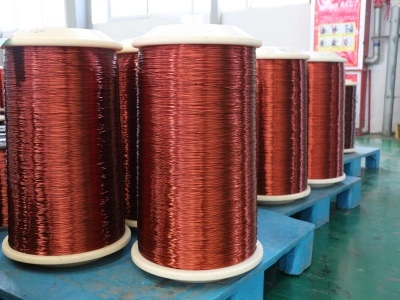
In the design and manufacturing of electromagnetic components, selecting the precise wire gauge is a fundamental engineering requirement. 18 gauge copper magnet wire (AWG 18) provides a specific balance of current-carrying capacity, low electrical resistance, and physical flexibility, making it a standard specification for medium-duty motors, transformers, and customized coil windings.
1. Material Standards and Purity
The foundation of high-performance magnet wire is the conductor core. To guarantee minimal power loss and maximum thermal stability, industrial-grade 18 gauge copper magnet wire is drawn from Electrolytic Tough Pitch (ETP) Copper (UNS C11000) or Oxygen-Free Copper (OFC).
Meeting international manufacturing standards ensures component reliability:
- Conductivity: Minimum 100% to 101.5% IACS (International Annealed Copper Standard).
- Manufacturing Standards: Fully compliant with NEMA MW 1000 (North America) and IEC 60317 (International) specifications for winding wires.
- Surface Finish: Precision-drawn to eliminate burrs and surface defects, preventing stress concentrations that could compromise the enamel insulation during the winding process.
2. Technical Specifications of 18 Gauge Copper Wire
For engineers calculating slot fill factors, winding resistance, and thermal loads, exact physical and electrical dimensions are critical. The table below outlines the standard bare wire parameters for AWG 18.
18 AWG Bare Copper Wire Parameter Table
| Technical Parameter | Metric Value | Imperial Value |
| Bare Wire Diameter | 1.024 mm | 0.0403 inches |
| Cross-Sectional Area | 0.823 mm² | 1624.3 Circular Mils |
| Electrical Resistance (at 20°C) | 20.95 Ω/km | 6.385 Ω/1,000 ft |
| Typical Ampacity (Current) | 10 – 16 Amperes* | 10 – 16 Amperes* |
| Nominal Weight | ~7.32 kg/km | ~4.92 lbs/1,000 ft |
| Tensile Strength (Annealed) | 200 – 250 MPa | 29,000 – 36,000 psi |
*Note: Safe operating ampacity is highly dependent on the duty cycle, winding density, cooling mechanism, and the insulation temperature class of the specific application.
3. Enamel Insulation and Thermal Classes
Because it is “magnet wire,” the 18 gauge copper core is coated with a highly durable polymer enamel film. The choice of insulation dictates the wire’s thermal endurance and chemical resistance. Manufacturers typically offer 18 AWG wire in various “builds” (Single, Heavy, or Triple insulation thickness) across multiple thermal classes:
- Class 155 (F) – Polyurethane (UEW): Excellent solderability without stripping. Ideal for coils and relays operating in moderate temperature environments.
- Class 180 (H) – Polyesterimide (PEW): High thermal stability and mechanical strength, frequently used in standard motor stators.
- Class 200/220 (N/R) – Polyamide-imide (EIW/AIW): Extreme chemical resistance and thermal durability. Engineered for heavy-duty industrial motors, hermetic compressors, and automotive alternators.
4. Engineering Applications: When to Specify 18 Gauge
Within a wire catalog, 18 gauge copper magnet wire is specified when a design requires more current capacity than finer gauges (like AWG 20 or 22) but demands tighter bending radii and a smaller footprint than thicker wires (like AWG 14 or 16).
Common industrial applications include:
- Motor Winding: Widely used in the stators and armatures of fractional horsepower (FHP) motors, power tools, and industrial pumps.
- Power Transformers: Utilized in both primary and secondary windings for medium-power step-down transformers and lighting ballasts.
- Electromagnetic Coils: The preferred gauge for heavy-duty relays, solenoids, and magnetic actuators where consistent magnetic flux density is required.
- Audio Equipment: Often selected for inductor coils in high-fidelity loudspeaker crossover networks due to its low DC resistance.
5. Conclusion
18 gauge copper magnet wire is a versatile and precisely engineered component vital to modern electrical infrastructure. By strictly adhering to NEMA or IEC standards, ensuring high copper purity, and selecting the appropriate insulation class, manufacturers can guarantee the efficiency and longevity of their magnetic components. Whether for an industrial motor or a custom transformer, referencing exact AWG 18 technical parameters is the first step in successful electromagnetic design.